
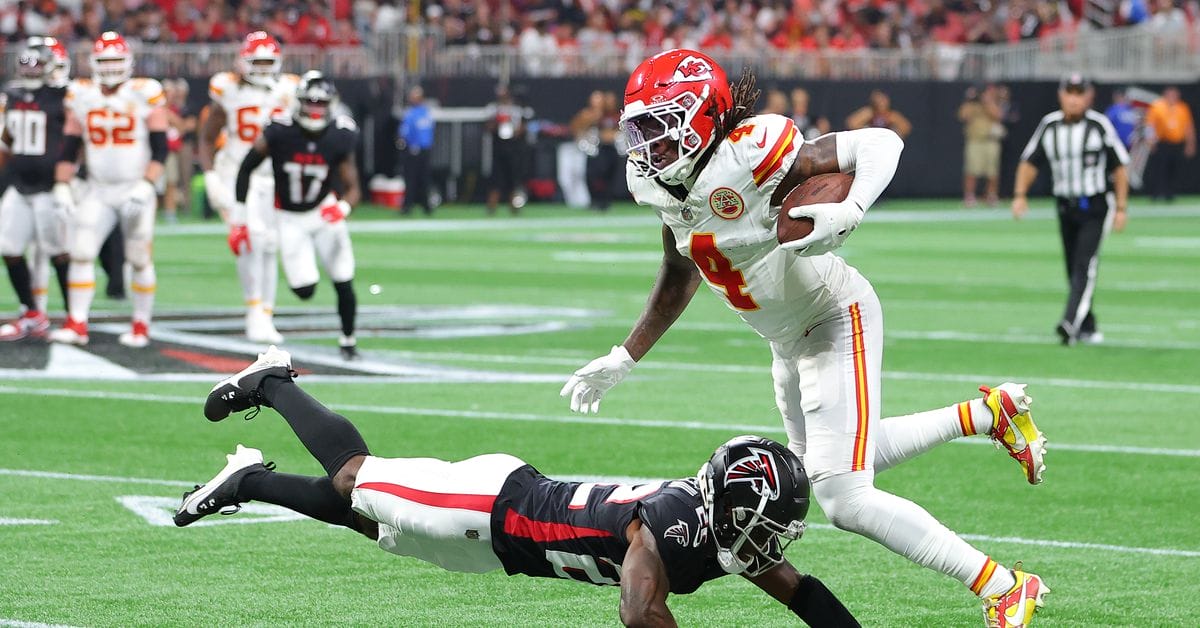

Adapting to Change: How the Chiefs Can Evolve Their Offense
Every handful of years, NFL teams experience transformations in personnel, schemes, and coaching staff. As the league evolves, it’s essential for teams to embrace new strategies that align with the current landscape of the game. The Kansas City Chiefs have exemplified this by adjusting their approach over the years.
The Evolution of the Chiefs under Patrick Mahomes
When quarterback Patrick Mahomes took charge in 2018, the Chiefs constructed an explosive offense centered around speed at the wide receiver position and Mahomes’ exceptional downfield passing ability. The strategy relied heavily on five players engaging in routes, leaving offensive tackles focused solely on pass protection.
However, as defenses began implementing two-high safety coverages to limit big plays, the Chiefs recognized the need for adaptation. They shifted their focus away from an over-reliance on speedy receivers, investing more resources into their offensive line and embracing 12 and 13 personnel to enhance their rushing attack. By 2022, this evolution hinged significantly on the performances of tight end Travis Kelce.
In the wake of their recent Super Bowl LIX loss, another evolution may be on the horizon. Kelce, now moving past his prime, is no longer the dominant force he once was. Younger wide receivers, such as Rashee Rice and Xavier Worthy, are emerging as key contributors.
The Next Phase for Kansas City
It’s intriguing to consider how the Chiefs can redefine their offensive identity at this juncture. One compelling direction might be to adopt elements from the Detroit Lions’ offense, which has arguably been the most potent in the league over the last couple of years. Given their current personnel, the Chiefs could successfully implement a system reflective of the Lions’ approach.
Understanding the Lions' Offensive Scheme
Detroit’s offensive philosophy begins with its commitment to the running game and a formidable offensive line. Although utilizing primarily 11 personnel, the Lions consistently find success in their rushing attacks thanks to an agile and powerful offensive line capable of executing various run schemes. Their linemen seamlessly adapt their approach based on the defensive alignment they’re facing.
Running back David Montgomery thrives between the tackles, while Jahmyr Gibbs excels in space with outside zone runs and pitch plays, providing a versatile dynamic that keeps defenses on their toes.
The passing game complements the running attack, featuring numerous under-center play action concepts that target the middle of the field. Wide receiver Amon-Ra St. Brown frequently runs crossers and dig routes from the slot, whereas speedster Jameson Williams stretches the field with downfield post routes. Tight end Sam LaPorta contributes as a reliable outlet with short drag routes and flat extensions.
This multi-faceted approach ensures that every passing concept includes vertical stretches, intermediate routes, and late-breaking underneath options, keeping defenses guessing. Additionally, the use of motion to create mismatches and free releases enhances the effectiveness of their receivers.
On critical downs, the Lions diversify their formations, employing motion and stacking techniques to replicate the advantages established in earlier plays.
Matching the Chiefs’ Personnel
The idea of incorporating elements of the Lions' scheme first struck me while considering player comparisons for Rice, who bears resemblance to St. Brown. When Rice was at peak performance in 2024, he showcased his ability to dominate on short crossing and dig routes, much like St. Brown. Given his skill set, Rice could step up as a flagship player in this type of offensive setup.
While Worthy may not mirror Williams perfectly, both players possess the speed necessary to operate effectively as deep threats on downfield posts. Worthy can potentially contribute more on shorter routes while Williams excels on deeper plays. Their skill sets could be leveraged in a similar manner within the structure of the offense.
Kelce's role in this scenario would need a thoughtful adjustment. LaPorta’s ability to block before releasing into passing zones illustrates a strategic use of tight ends, suggesting that Kelce could embrace more of a blocking-oriented role. By committing to this style, Kelce could benefit from tactical route timing that releases him into effective underneath opportunities, leading to efficient production without the pressure of needing to dominate the middle of the field.
Running Game Considerations
While the Chiefs may not possess the offensive line talent of the Lions, they still have the capacity to adopt elements from their running game. With Kingsley Suamataia potentially stepping in as left guard, the Chiefs could form a dynamic and robust interior offensive line. Although Joe Thuney remains solid in pass protection, his run-blocking effectiveness has diminished with age. If Suamataia develops as anticipated, he could thrive within an outside zone scheme reminiscent of the one executed by the Chiefs’ new left tackle, Jaylon Moore, during his tenure with the San Francisco 49ers.
Key Ingredients for Success
A Dynamic Running Back
Key to the Lions’ offensive style is a standout running back capable of turning well-blocked plays into significant gains. Gibbs exemplifies this ability, possessing the speed and agility to convert a standard five-yard run into a substantial gain. At present, the Chiefs lack any running back who can produce at that level, and acquiring a dynamic player would be a top priority for them to implement this system effectively.
An X-Wide Receiver
After the Super Bowl, it became clear that the Chiefs need a one-on-one receiver adept at winning against man coverage. However, this perspective may be shifting. With Rice positioned as a primary weapon and Worthy offering versatile contributions, the immediate need may not be as critical. Nonetheless, recruiting a reliable X receiver who can block, catch slants, and secure crucial gains would be beneficial. The Lions have effectively utilized players like Josh Reynolds and Tim Patrick in this capacity. The Chiefs could find a player fitting this role in the third or fourth round of the draft.
Enhanced Tackle Play in the Running Game
This area highlights a crucial need for improvement. Kansas City’s current tackles do not match the prowess of the Lions’ Penei Sewell and Taylor Decker. While the interior of the offensive line exhibits potential within this offensive scheme, securing physical, run-blocking tackles is imperative. Moore may serve this purpose to an extent, but concerns linger about Jawaan Taylor’s functionality within this framework. For the Chiefs to successfully transition in this direction over the next few years, drafting a right tackle currently exhibiting these capabilities would be prudent, setting the stage for future offensive growth.
In summary, the Kansas City Chiefs stand at a crossroads, ripe with opportunities to evolve their offensive identity. By learning from the successes of teams like the Detroit Lions and strategically adjusting their personnel, they can adapt their approach to thrive in the ever-changing landscape of the NFL. 🏈✨